
In this article7 sections
A steadier Darwin market doesn’t do a buyer’s homework. Land tenure, cyclone-rated construction and flood mapping still decide what a home is worth, so check them before you settle on a price.
Darwin and the Northern Territory have historically been Australia's most volatile property market, with multi-year boom and bust cycles tied to resource sector activity, federal infrastructure spending and population swings. The 2020 to 2022 boom was followed by a softer 2023 and 2024. In 2026, the market is more stable, with structural supports finally translating into consistent if modest growth.
Where the median sits
Darwin's median house price has reached around $610K in mid-2026, up around 4.1% year-on-year. Units sit at $370K. Days on market average 38 to 50, longer than southern capitals but shorter than the 60+ days seen during 2023's softer patch. The market is balanced rather than overheated.
Where Darwin is firming
Established Darwin suburbs in the inner northern suburbs (Nightcliff, Rapid Creek, Coconut Grove, Fannie Bay) continue to attract demand for character housing with bay outlooks. The Stuart Park and Larrakeyah inner ring also remains tightly held. Newer estates through Palmerston (Bellamack, Johnston, Zuccoli) provide accessible price points and have stabilised after several years of softness.
The unique NT property considerations
Land tenure in the NT is different from southern states. Outside the towns, most NT land is either pastoral leasehold or Aboriginal freehold, which is held by land trusts under the Aboriginal Land Rights (Northern Territory) Act and can't be sold. In established Darwin suburbs, the average house block is ordinary freehold, as it is down south. Always engage an NT-qualified conveyancer who understands the local tenure landscape.
Climate considerations
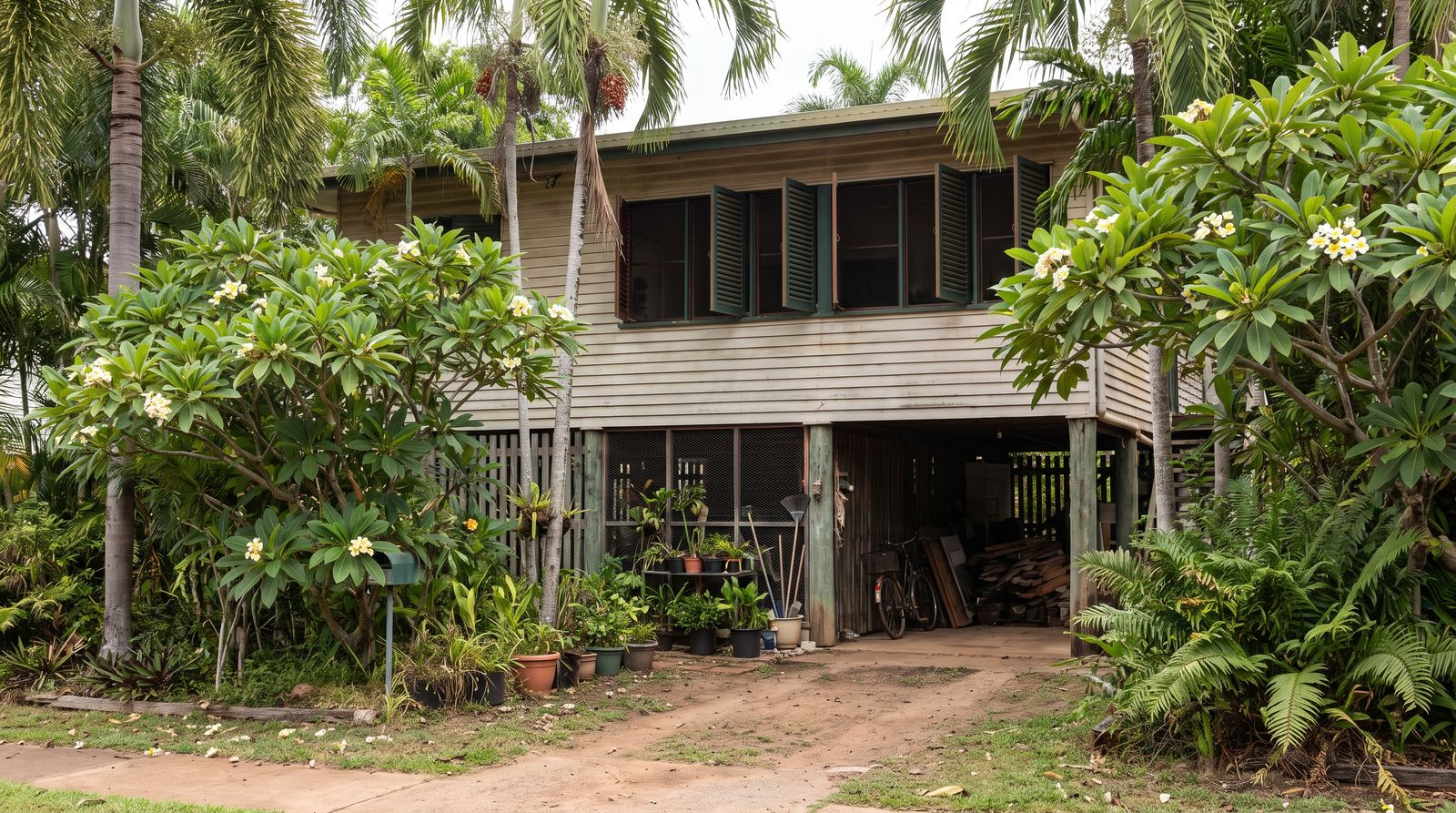
Darwin's tropical climate creates property considerations that don't apply elsewhere. Cyclone-rated construction (post-Cyclone Tracy 1974), air conditioning, insulation, and flood/inundation exposure are all material to property selection. Buyers should always commission building inspections that explicitly cover cyclone-zone compliance and check the suburb's storm surge and flood mapping.
Alice Springs and regional NT
Alice Springs and Katherine offer the most affordable options in the territory, with house medians of $400K to $480K. Both markets have struggled with higher volatility through 2024, but yield levels remain attractive for investors prepared to weather the local market cycles. Remote community housing operates under different frameworks entirely and is generally not a market for standard residential investors.
The rental story
Darwin's rental market has been tight through 2025 and 2026, with vacancy at 1.2% in Q1 2026 and weekly rents up 5 to 8% year-on-year. Defence sector employment, government public service, and resource sector activity all support sustained rental demand. Yields in outer-Darwin and Palmerston remain compelling at 5 to 6% gross.
What to expect through 2026
- Continued stable growth, 3 to 6% annually, with less volatility than the 2020 to 2024 cycle
- The $50,000 HomeGrown Territory Grant for a first home buyer building or buying a new home (contracts to 30 September 2027) is the largest first home grant in Australia. There's no first home stamp duty concession, and the $10,000 grant for established homes closed to contracts after 30 September 2025
- The federal 5% Deposit Scheme (First Home Guarantee) cap rose from $600,000 to $750,000 in Greater Darwin on 1 July 2026, above the median house price; it stays at $600,000 in the rest of the NT
- Defence and resource sector employment support medium-term rental demand
- Climate-resilient construction premiums likely to widen as insurance costs rise
The NT in 2026 is not a market for casual interstate investors. The tenure complexities outside Darwin, climate considerations, and historical volatility all require local expertise. But for owner-occupiers and patient investors with NT context, the combination of strong yields, lower entry prices, and the largest first home grant in Australia on a new home makes a compelling case.
Keep reading
- First home buyer guide, NTGrants and duty rules for first buyers in the Territory.
- NT market reportMedian prices, growth, suburb rankings.
- House price forecasts for 2026 and 2027 by capital city: what CBA, Westpac, NAB, ANZ and Domain expect, and what has happened so farEvery major forecaster cut its 2026 house price outlook between March and August 2026. The current numbers for Sydney, Melbourne, Brisbane, Perth, Adelaide, Hobart, Canberra and Darwin, each dated and sourced, set against what Cotality's index actually recorded to August, and how to read them if you are deciding whether to sell.
- Late-July wrap: Wednesday's inflation number, the August rate call, and the first buyer's-market spring in yearsThe June-quarter inflation figures land on 29 July and the RBA decides on 11 August — the two dates that will set the tone for spring. With clearance rates around 50%, more stock on market and every major bank trimming its forecasts, spring 2026 is shaping up as a season that rewards preparation over momentum.
- The cheapest suburbs in every Australian capital city, ranked (Winter 2026 report)Across Australia's eight greater capitals, just eight verified suburbs still carry a median house price under $500,000 — and in Sydney, Adelaide and Canberra the entry price has moved past $700,000. We ranked the cheapest verified suburb in every capital, plus the regional towns where a house still costs less than $250,000.